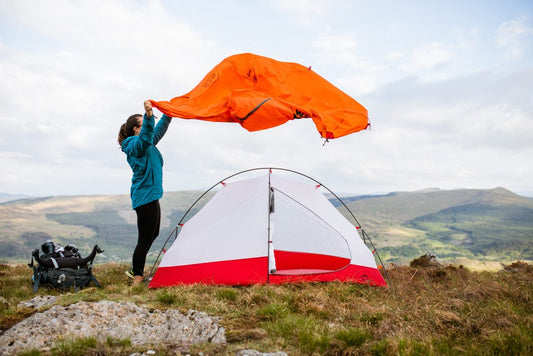
There's a moment every campervan and motorhome traveller knows well. You pull into a quiet spot beside a lake, a loch or a slow river, the kettle goes on, and you look out at that flat, glassy water and think: I wish I could get out there.
For a lot of us, the answer used to be a kayak strapped to the roof. That means a roof rack, a ladder, a 20 to 30kg boat to lift overhead, a higher vehicle, more wind noise on the motorway, and a nagging worry about car parks with height barriers. Plenty of people decide it simply isn't worth the faff, and the water stays something you look at rather than something you're on.
We think there's a better way, and it fits in a locker.
What is a packraft?
A packraft is a small, tough, inflatable boat designed to be carried. It was born in the wilderness, where hikers needed a boat they could fit in a rucksack to cross rivers and lakes (you can read a short history of the packraft here). That same obsession with low weight and small size is exactly what makes a packraft such a good companion for van life.
Our Paddle Ready Lightweight packraft weighs 3.2kg. That's lighter than most people's weekly shopping. Rolled up, it tucks into an overhead locker, under a seat, in the garage of a motorhome or in the corner of a campervan boot, alongside your chairs and your wellies.
Why packrafts suit campervans and motorhomes so well
1. No roof rack, no heavy lifting
This is the big one. There's no boat to haul up onto the roof and no ladder to climb. You carry a packraft from the van to the water in one hand, or over your shoulder, and inflate it at the water's edge. If your back, shoulders or knees have opinions about lifting a hard kayak overhead, a packraft is a very different proposition.
2. It lives inside the van
Space is the currency of van life, and every bit of kit has to earn its place. A packraft packs down small and doesn't care whether it's stored on its side, under the bed or behind a seat. It stays out of sight, out of the weather and out of the way of thieves, and your van's height and fuel economy stay exactly as they are.
3. Quick to set up, quick to pack away
Every Paddle Ready packraft comes with an inflation bag, which works a bit like a big lightweight sack that you scoop full of air and squeeze into the boat. No pump required, and you're usually on the water in a few minutes. We have a full guide on how to inflate a packraft if you'd like to see how it works. At the end of the day, open the valve, roll it up and it's back in the locker.
4. Stable, comfortable and forgiving
Packrafts are wide and sit low on the water, which makes them reassuringly stable on calm lakes and gentle rivers. You sit on an inflatable seat rather than a hard moulded one, and on our Paddle Ready+ there's an inflatable backrest too, which makes a real difference on a longer, lazier paddle.
5. It turns every stop into a possibility
Because the boat is always with you, you stop planning trips around "paddling destinations" and start noticing water everywhere. A loch beside a lay-by in the Highlands. A reservoir next to a campsite in the Peak District. A slow French river running behind an aire. Morning coffee on the water before anyone else is up. That's the real magic.
Getting in and out: an honest word
We'd rather be straight with you. A packraft sits right down at water level, so getting in and out takes a little technique, especially if your knees and hips aren't as bendy as they once were. A few things that help:
- Choose a gently shelving bank or beach rather than a high jetty or steep edge.
- Sit on the side tube first, then swing your legs in and slide down onto the seat. Reverse the process to get out.
- Keep the paddle across the boat and use it as a brace on the bank.
- Practise in shallow, calm water on a warm day before your first proper outing. After a couple of goes it becomes second nature.
If you're travelling as a couple, having one person steady the boat while the other gets in makes things even easier.
Which packraft is best for van travel?
For most campervan and motorhome owners who want gentle paddles on lakes, lochs, canals and slow rivers, we'd point you towards the Paddle Ready Lightweight. At 3.2kg it's the lightest and simplest in our range, and it comes with the seat and inflation bag included.
If you'd like a little more comfort and capability, the Paddle Ready+ (3.7kg) adds a backrest, a removable spray deck to keep you warm and dry on breezy days, and a removable skeg that helps the boat track straight on open water. For longer trips, the Paddle Ready+ TIZIP adds a waterproof zip so you can store kit inside the tubes.
You'll also need a paddle. The RUK Sport Moray 4-piece paddle splits into short sections that store neatly in a van, and you get £10 off automatically when you buy it with a packraft.
Where can you paddle? The UK and Europe
England and Wales
Many canals and rivers in England and Wales need a waterways licence. The simplest route is membership of Paddle UK, which includes a licence for most Canal & River Trust and Environment Agency waters. Lakes and reservoirs vary, so check with the owner or campsite before you launch. Our top 5 packrafting locations in the UK is a good place to start.
Scotland
Scotland is a dream for packraft-carrying vans. Under the Scottish Outdoor Access Code you have a right of responsible access to most inland water, and the combination of lochs and roadside stopovers is hard to beat. Read about our trip on Loch Etive for a taste of it.
Europe
Taking the van across the Channel? A packraft is the ideal travelling boat because it adds nothing to your vehicle's height or length. France's network of aires puts you beside rivers and lakes all over the country, the Scandinavian countries have generous traditions of access to nature, and the lakes of the Alps are spectacular from water level. Rules differ from country to country and even lake to lake, with some waters closed to boats entirely, so always check local signage or ask at the campsite.
Staying safe on the water
- Always wear a buoyancy aid. It's the single most important piece of kit you'll own.
- Respect cold water. UK lakes and rivers are cold for much of the year, so dress for a swim, not for the air temperature. Our post on staying warm as a packrafter has plenty of ideas.
- Watch the wind. Packrafts are light and can be blown about. On lakes, avoid wind blowing away from the shore, and stay close to the edge until you know how your boat handles.
- Start small. Calm, sheltered water first. Moving water and the sea are for later, with the right skills and company.
- Tell someone your plans, or better still, paddle together.
Looking after your packraft on the road
Van life is easy on a packraft as long as you follow one golden rule: dry it before you store it for any length of time. Packing it away wet for a day or two on the move is fine, but give it a rinse with fresh water and let it dry fully once you're parked up for a while, especially after salt water. Store it away from sharp edges and direct heat. Our cleaning and maintenance guide covers everything else, and if you travel with a four-legged co-pilot, have a look at our tips for packrafting with your dog.
The water was always there
You've already done the hard part. You've got the van, you've got the time, and you've got the curiosity to go and see what's around the next bend. A packraft simply lets you keep going when the road runs out at the water's edge.
If you've got questions about which boat suits your van, or how you'll get on with one, drop us a line. We're always happy to talk boats, and we'd love to see where yours takes you.